
Global Financial Support
Where the USD Is Officially Used Around the World
The United States Dollar (USD) is one of the most powerful and widely used currencies in the world. While it is the official currency of the United States, several other countries and territories also use the U.S. Dollar either as their official currency or alongside their local currency. This practice is known as dollarization.
In this article, we will explore the countries that use the U.S. Dollar, why they use it, and the benefits and challenges of adopting the USD.
What Is Dollarization?
Dollarization occurs when a country uses the U.S. Dollar instead of, or alongside, its own national currency. Governments choose this system mainly to:
- Stabilize their economy
- Control inflation
- Increase investor confidence
- Simplify international trade
Many smaller economies adopt the USD because it is considered a stable and globally trusted currency.
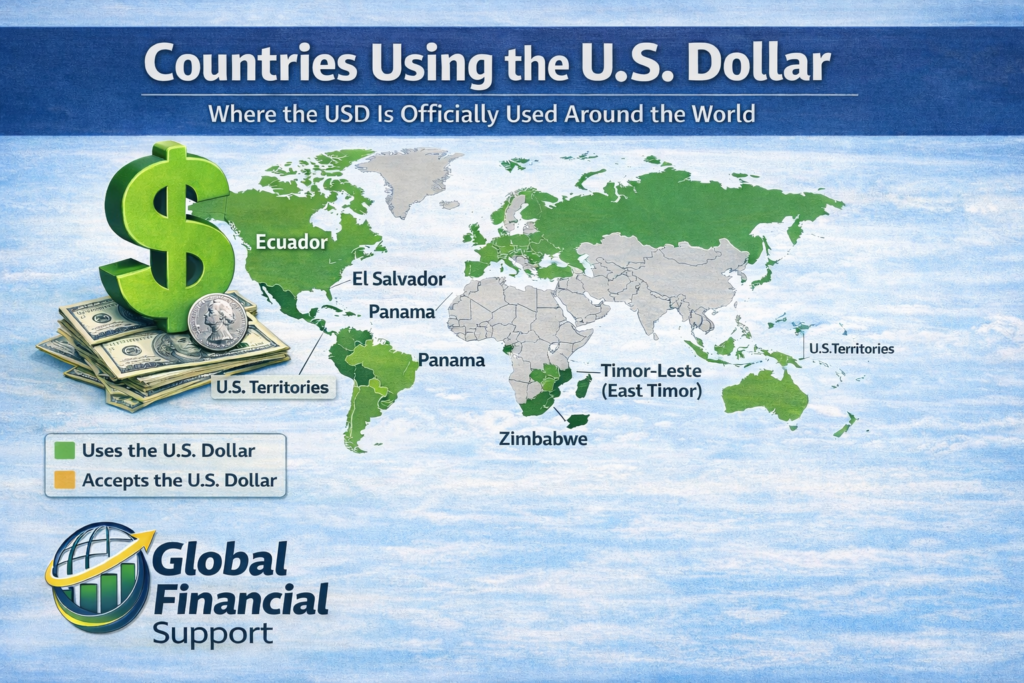
Countries That Officially Use the U.S. Dollar
Some countries have completely replaced their national currency with the U.S. Dollar as their official legal tender.
1. Ecuador
Ecuador adopted the U.S. Dollar in 2000 after a severe financial crisis and high inflation. Dollarization helped stabilize the economy and restore financial confidence.
2. El Salvador
El Salvador introduced the U.S. Dollar in 2001 alongside its former currency, the Colón. Over time, the USD became the dominant currency used in daily transactions.
3. Panama
Panama has used the U.S. Dollar since 1904. Although Panama has its own coins called the Balboa, paper currency is entirely in U.S. Dollars.
4. Timor-Leste (East Timor)
Timor-Leste adopted the U.S. Dollar in 2000 after gaining independence. The country issues its own coins, but the primary currency remains the USD.
5. Zimbabwe
Due to extreme hyperinflation, Zimbabwe abandoned its local currency in 2009 and began using several foreign currencies, including the U.S. Dollar.
U.S. Territories That Use the Dollar
These regions are territories of the United States, so they naturally use the U.S. Dollar:
- Puerto Rico
- Guam
- U.S. Virgin Islands
- American Samoa
- Northern Mariana Islands
Residents use the same currency as the mainland United States.
Countries That Accept the U.S. Dollar Informally
In many countries, the U.S. Dollar is not official, but it is widely accepted for tourism, trade, or large transactions.
Examples include:
- Cambodia
- Lebanon
- Argentina
- Venezuela
- Peru
- Costa Rica
In these economies, people often prefer holding USD because it is more stable than the local currency.
Advantages of Using the U.S. Dollar
Countries adopt the U.S. Dollar for several economic benefits:
1. Economic Stability
The USD is one of the most stable currencies, helping countries control inflation.
2. Increased Foreign Investment
Investors feel more secure operating in economies that use a globally trusted currency.
3. Simplified Trade
Using the USD reduces exchange rate risks in international trade.
4. Lower Interest Rates
Dollarized economies often benefit from lower borrowing costs.
Challenges of Dollarization
While dollarization offers benefits, it also has disadvantages.
1. Loss of Monetary Policy Control
Countries cannot print money or control interest rates when they use the USD.
2. Dependence on the U.S. Economy
Economic decisions made by the U.S. Federal Reserve can impact dollarized countries.
3. Limited Financial Flexibility
Governments lose tools to manage economic crises.